
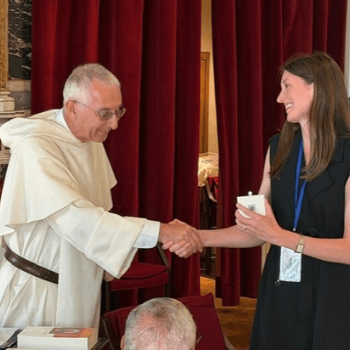
Bridget Knuffke is a MODG class of 2013 graduate. We are so glad to have had the chance to hear about her journey to receiving the 2024 Prize of the Pontifical Academies from the Pontifical Academy of St. Thomas Aquinas! Read the interview below:

Can you share a bit about your MODG experience and how you feel it prepared you for your future?
I really enjoyed the MODG curriculum. In high school, I took several online courses, which connected me with outstanding teachers and fellow students. The Ancient History and Medieval History courses were some of my favorites. We read and discussed interesting texts, which opened up the world to me in a new way. I especially appreciated the emphasis on writing in the MODG curriculum. I felt extremely well prepared for writing college essays and research papers.
Where did you go to college, and what did you study?
I went to the University of Dallas and got a degree in philosophy, along with completing the prerequisites for medical school.
What higher education did you pursue after your bachelor’s degree?
After I graduated from the University of Dallas, I went to the School of Philosophy at the Catholic University of America, where I received my master's and doctoral degrees. After I finished at CUA, I held a year-long postdoctoral research fellowship at Princeton University.
Can you share more about your doctoral dissertation and the road to receiving the 2024 Prize of the Pontifical Academies?
I wrote my dissertation on Thomas Aquinas under the direction of F. Russell Hittinger on Thomas's understanding of medicinal punishment. Thomas often says that punishment is "like a medicine," which is a notion he draws from Aristotle. Medicinal punishment gets to the heart of Thomas's understanding of what punishment is and its very purpose. When a surgeon cuts open a patient's body, he harms him, but we characterize this harm in light of its end: the health of the patient. Similarly, punishment is harmful in a very real sense, but if we view it in light of its end--restoring the equality of justice and reforming the offender, for example--we can see that the punishment is necessary to bring about this good. In 2024, the Pontifical Academy of St. Thomas Aquinas awarded me the Pontifical Academies Award for my dissertation. There are ten Pontifical Academies, and each year one of the Academies is selected to grant this award on behalf of all the Pontifical Academies. The Pontifical Academy of St. Thomas Aquinas has only awarded this prize twice in the past 25 years or so, and it was a great honor to receive it for my research!
Congratulations Bridget and thank you for taking the time to share your story with us! What a wonderful accomplishment!