
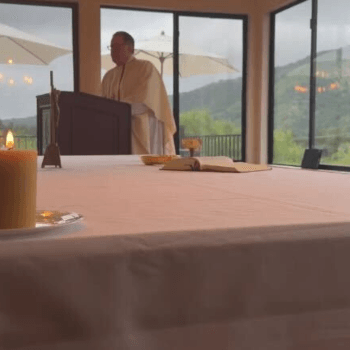
I have this wonderful opportunity to celebrate Sunday Mass here, in this beautiful home, as kind of the conclusion of this great day of instruction. Instruction about instruction. Which puts us where we are; we are just about the midpoint of the time of instruction.
After the Resurrection, St. Luke tells us that Jesus spent 40 days teaching his disciples, well, teaching to those he chose, about the coming of the Kingdom of Heaven. And I think the way to understand that is he was teaching the disciples, the first bishops, about how the Church was to be founded, how it was to be built up and administered. And so, every year after the Resurrection, after Easter, we spend a week just remembering and celebrating that feast. It takes a whole week. But from there going forward to the Ascension, we actually receive that instruction. We’ve been hearing all week long about the Eucharist. In the first reading we’ve been hearing about the exploits in the early church in the Acts of the Apostles, all the way from the events we heard this evening, Peter’s sermon on Pentecost. But today that really hits us hard because we’re on the way to Pentecost, and remember, that’s the same Peter who couldn’t face up to a serving girl in the dark outside the home of Caiaphas and denied the Lord three times because he didn’t have the courage even to say he knew Jesus. Fifty days later, he has all the courage to stand up before that whole crowd and confront them with their sins as we heard. They were struck to the heart and three-thousand of them were baptized. Just to know, in those days from the Ascension to Pentecost, the Church, all of us, were in one room. One room. Think of, this is fifty or so here right now and we all fit in one room, but that’s the last time the church fit in one room. At Pentecost three-thousand were added and now suddenly we’re starting to spread.
Over these weeks we’ve also heard about Peter and John going to the temple and they heal a crippled man, and now there’s another five-thousand. Pretty soon it’s growing leaps and bounds. This past week we heard the next major growth, and that’s persecution. With the death of Stephen. Saul becomes St. Paul; he sets out to destroy Peter, he goes against his teacher who says “don’t fight against him” but he did anyway. And then that result was that we started to go everywhere.
Our Lord, when he was ascending into heaven, he said to wait in Jerusalem for the gift of the Holy Spirit, the gift of the Father. But he said when he comes upon you he will give you power, to go to all nations, to go through Jerusalem, Judea, Samaria and the ends of the earth. We’re at the ends of the earth, and thank heavens they came here. Through many many years, each of us received the faith, through many sacrifices and the gifts of so many. And here we are, right about that midpoint. And what is it that the Church asks us to focus on today? Firstly, the church is built on the rock of Peter. So our first reading talks about his sermon to all those people back there then, that makes it more comfortable. He’s convicting them of their sins. But then the church says this in the second reading, he said, “Beloved, if you are patient while you suffer for doing what is good this is a grace before God, for this you have been called.” He goes on to say this, he talks about how our Lord did exactly that, he did in turn no insult when he suffered, he didn’t threaten, he handed over himself to one of the judges. He himself bore our sins in his body on the cross, notice, not their sins, OUR sins.
By his wounds, YOU have been healed. All the sudden, the church moves from purely saying this thing to those people way back then, Peter is saying those things to us. It’s by the salvation of Christ, it’s by his saving power, that we’re able to sit here right now and attend this mass. That’s I think the thing we need to see because in the gospel we hear the Lord compare himself to a shepherd, and we might think he’s confused because he also then compares himself to the gate that the shepherd opens up for the sheep to go through. But he only had to go there because the people who were listening to him missed the point of the shepherd. The shepherd opens the gate to let us go out to pasture, and we heard the Psalm, that shepherd is an amazing thing, he leads the sheep so well that they lie down in green pastures. Think for a moment, what does it take for a sheep to lie down in a green pasture? It has to be not worried about anything, and it’s not hungry either, it’s fed. The Lord is the kind of shepherd that makes sure we have everything we need and nothing to worry about, that’s who the shepherd is. But he does this in the face of our foes, he sets the table before us in the midst of our foes and yet we can lie down in green pastures. And so, the church gives us some version of this parable every year. This year we’re getting it from the gospel of John, but sometimes we hear it from the others and there are slightly different details, but the point is this, if we were cattle, the Lord would have to drive us. He would get behind us and we’d have to run away from him. But he doesn’t say we’re cattle, he says we’re sheep. Sheep walk behind the shepherd, sheep trust the shepherd and we follow him. And so it’s no mistake that the church gives us an account every year of Peter as the one who we’re to follow.
All week long we’ve been hearing about the Eucharist around which and upon which the church is built, and now we hear about Peter who is to lead us in coming to the Eucharist. So he says, “the gatekeeper opens for him, the sheep hear his voice, the shepherd calls his own sheep.” Now what are we to make of it that the Lord calls himself the gate? There is no other way for us to get to heaven than through Jesus, through his name. It’s as simple as that. If we could pose all the kinds of different ways to get there… I know walking in you had a number of different scenarios for how to teach classical education, and there are lots of different ways. There is only one way to come to salvation, and it’s through our Lord, it’s through the holy mass, it’s through the Eucharist. But it’s in union with those upon whom he built the church.
So, on this evening, as we begin to celebrate what we’ve come to call Good Shepherd Sunday, just one last note, if you remember the first week of the Easter octave, we heard many many accounts of Jesus appearing to one or another or a group and so often they couldn’t recognize him. Not at first. The two on the way to Emmaus recognized him in the breaking of the bread, but there’s this mystique. If you asked yourself, why do we hear about these appearances and not others? Well, St. Luke tells us he only appeared to the ones he chose to appear to. St. John tells us he appears to others too, but “I didn’t write about those. If I tried to write about everything he did there wouldn’t be enough books in the world” They wrote about these so that you can come to know that Jesus is the Christ. It comes right back to this again, it’s these stories about ancient people but they’re directed to us. They’re directed so that we can KNOW, not just think, but to know that Jesus is the Christ, and it’s through him that we have salvation.
Notice this, the thing that’s common about every single one of those encounters after the Resurrection: Mary Magdalene, Peter and John, the disciples on the sea of Galilee, the two on their way to Emmaus; in each case we hear of him going after a lost sheep. We see our Lord being that good shepherd, we see him going after the sheep that need him. And so he comes to us and we know his voice, he comes to us today, comes to us each, he wants us to come near him, to come into the sheepfold through him to be with him forever and ever.